
The Different Types of Boundaries — and How to Identify Yours
Boundaries protect your time, energy, emotions and well-being. Here are seven kinds, and a simple way to find the ones you need.
Key ideas
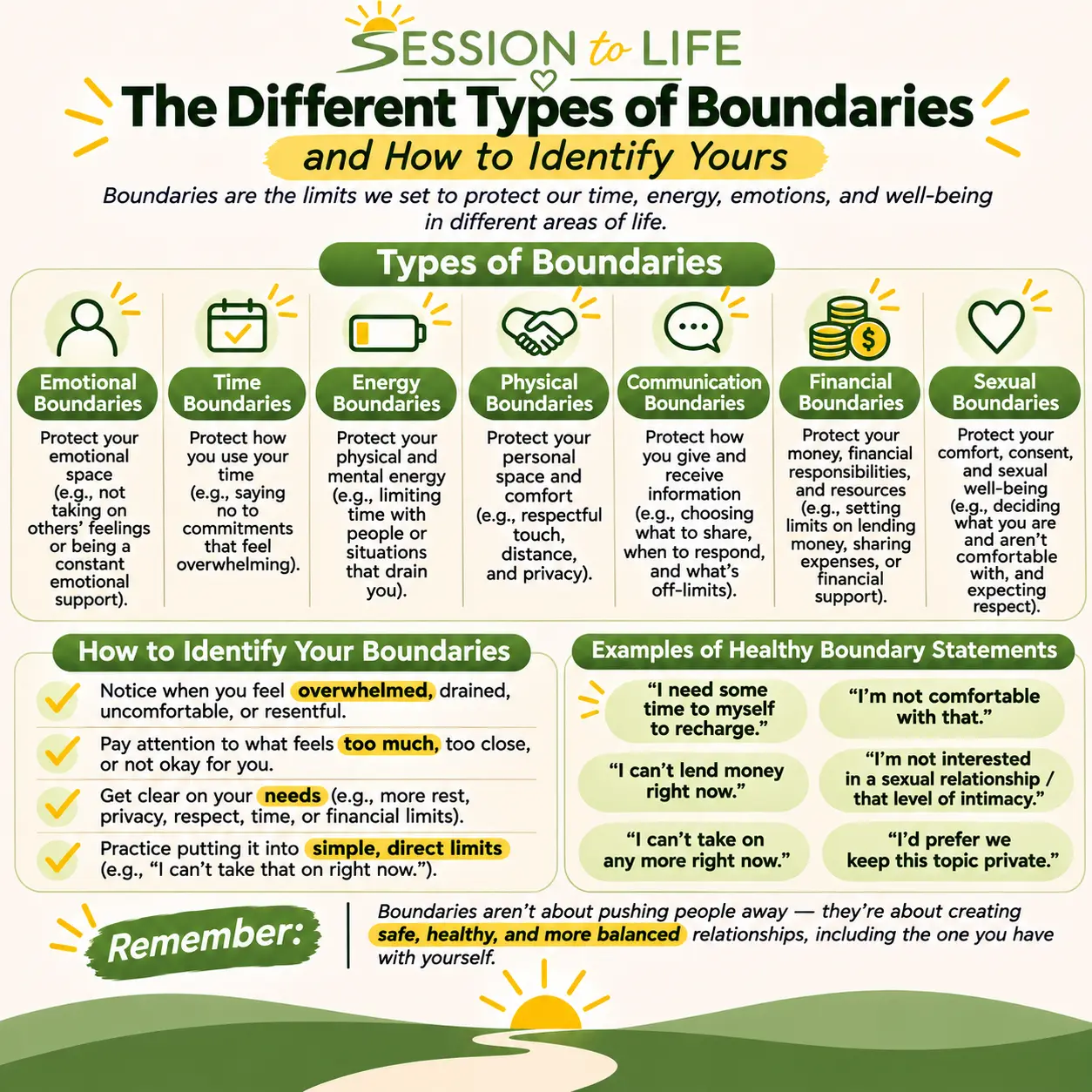
- There are seven common types: emotional, time, energy, physical, communication, financial and sexual.
- Feeling overwhelmed, drained or resentful is often a sign a boundary is needed.
- A boundary can be one short, direct sentence.
The seven types
Emotional boundaries protect your emotional space, like not taking on everyone's feelings. Time boundaries protect how you spend your hours. Energy boundaries limit people or situations that drain you. Physical boundaries protect personal space, touch and privacy. Communication boundaries decide what you share and when you respond. Financial boundaries protect your money and resources. Sexual boundaries protect your comfort and consent.
How to notice what you need
Your feelings are information. Pay attention to moments that feel like too much, too close, or not okay. Resentment in particular often points to a place where you keep saying yes when you mean no. From there, name the need underneath: more rest, privacy, respect, time, or financial limits.
Putting it into words
You don't need a long explanation. Try: “I need some time to myself to recharge.” “I can't lend money right now.” “I'm not comfortable with that.” “I'd prefer we keep this topic private.” Boundaries aren't about pushing people away; they make relationships safer, including the one you have with yourself.
Try this
Pick the one type of boundary that feels hardest for you right now. Write one sentence you could say to protect it this week.
Time Boundary Scenario
A coworker asks you to stay late again, but you already feel stretched thin and need to go home.
ReadEnergy Boundary Scenario
Someone wants to keep talking and making plans, but you already feel mentally and physically drained.
Read