
Parental Boundaries: Finding Balance in What We Share
Between oversharing and saying nothing is a healthy middle: honest, simple and age-appropriate.
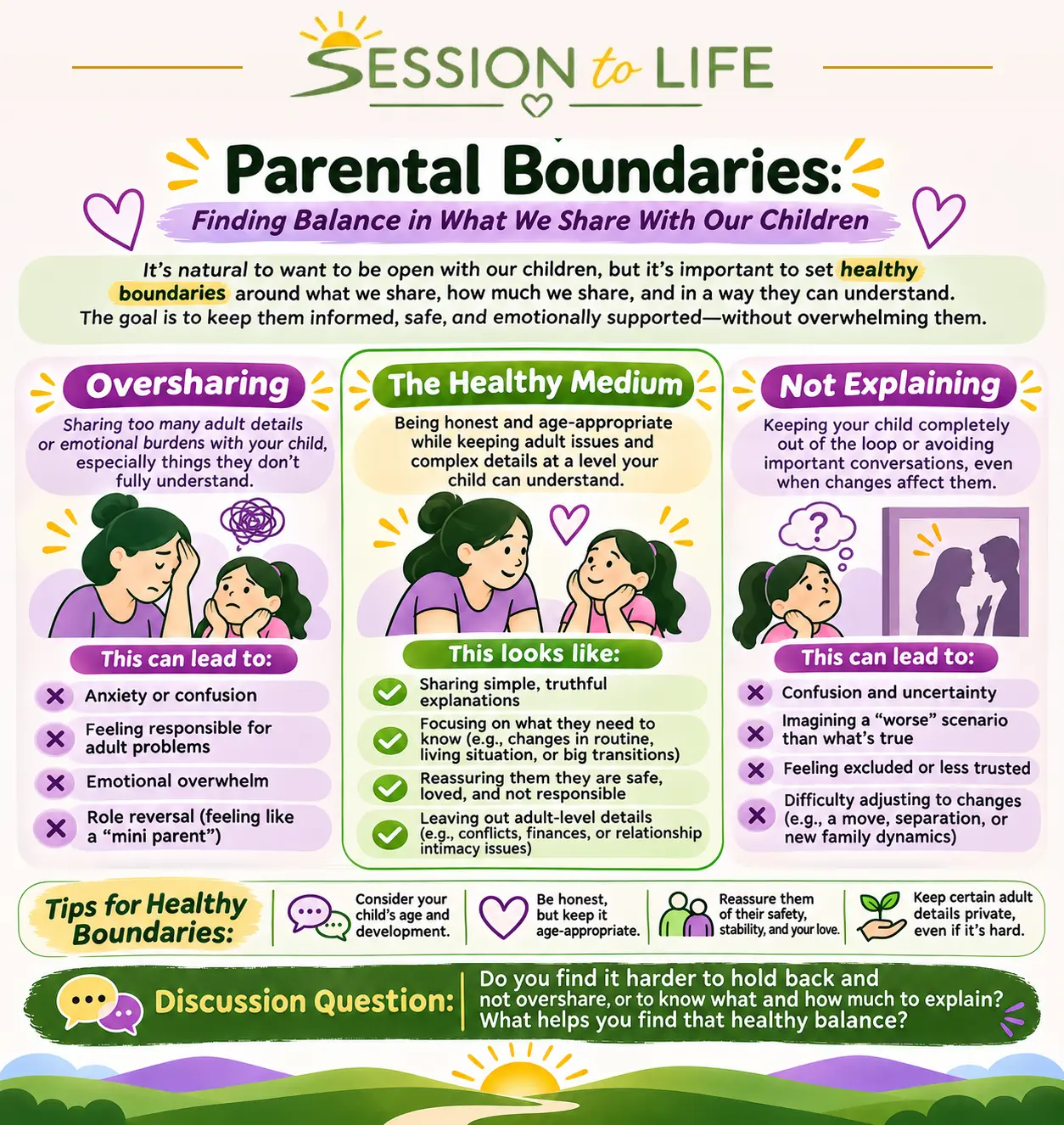
Key ideas
- Oversharing can leave children anxious or feeling responsible for adult problems.
- Not explaining can leave them imagining something worse than the truth.
- The healthy medium is simple, truthful and reassuring.
Oversharing
Sharing adult details or emotional burdens with a child can lead to confusion, emotional overwhelm, and role reversal, where a child starts acting like a “mini parent.”
Not explaining
Keeping children completely out of the loop, even when changes affect them, can lead to uncertainty, feeling excluded or less trusted, and difficulty adjusting to a move, a separation or new family dynamics.
The healthy medium
Share simple, truthful explanations focused on what they need to know, like changes in routine or where they'll live. Reassure them they are safe, loved and not responsible. Leave out adult-level details such as conflicts, finances or intimacy issues. Consider their age, and keep some details private even when it's hard.
Try this
Do you lean toward oversharing or holding back? Think of one change your child is facing and write a two-sentence, age-appropriate explanation.
Time Boundary Scenario
A coworker asks you to stay late again, but you already feel stretched thin and need to go home.
ReadEnergy Boundary Scenario
Someone wants to keep talking and making plans, but you already feel mentally and physically drained.
Read